Air Quality & Emissions
Understand your emissions, your permitting obligations, and what your facility needs to do next.
Air-quality requirements can affect a facility when new equipment is installed, production increases, operations change, fuels or materials are modified, or existing permits no longer reflect how the facility operates.
Summit Environmental provides air-quality permitting, emissions evaluation, monitoring, and compliance support for industrial, commercial, manufacturing, and other facilities that need to understand their emissions profile and applicable regulatory requirements.
Our work is designed to determine what sources are emitting, what pollutants are involved, what permitting or reporting requirements may apply, and what steps are necessary to maintain compliance as operations change.
Effective air compliance begins with understanding how the facility actually operates.
Air-quality evaluations should be based on the equipment, processes, materials, fuels, operating schedules, and production levels that exist at the facility.
Summit reviews facility operations to identify potential emission sources and understand how those sources relate to permitting, reporting, monitoring, and recordkeeping requirements.
Potential sources may include boilers, heaters, generators, storage tanks, process vents, coating operations, material handling, combustion equipment, dust-producing activities, and other emission-generating processes.
The objective is to translate facility operations into a clear environmental picture so clients understand both their current obligations and how future operational changes may affect them.
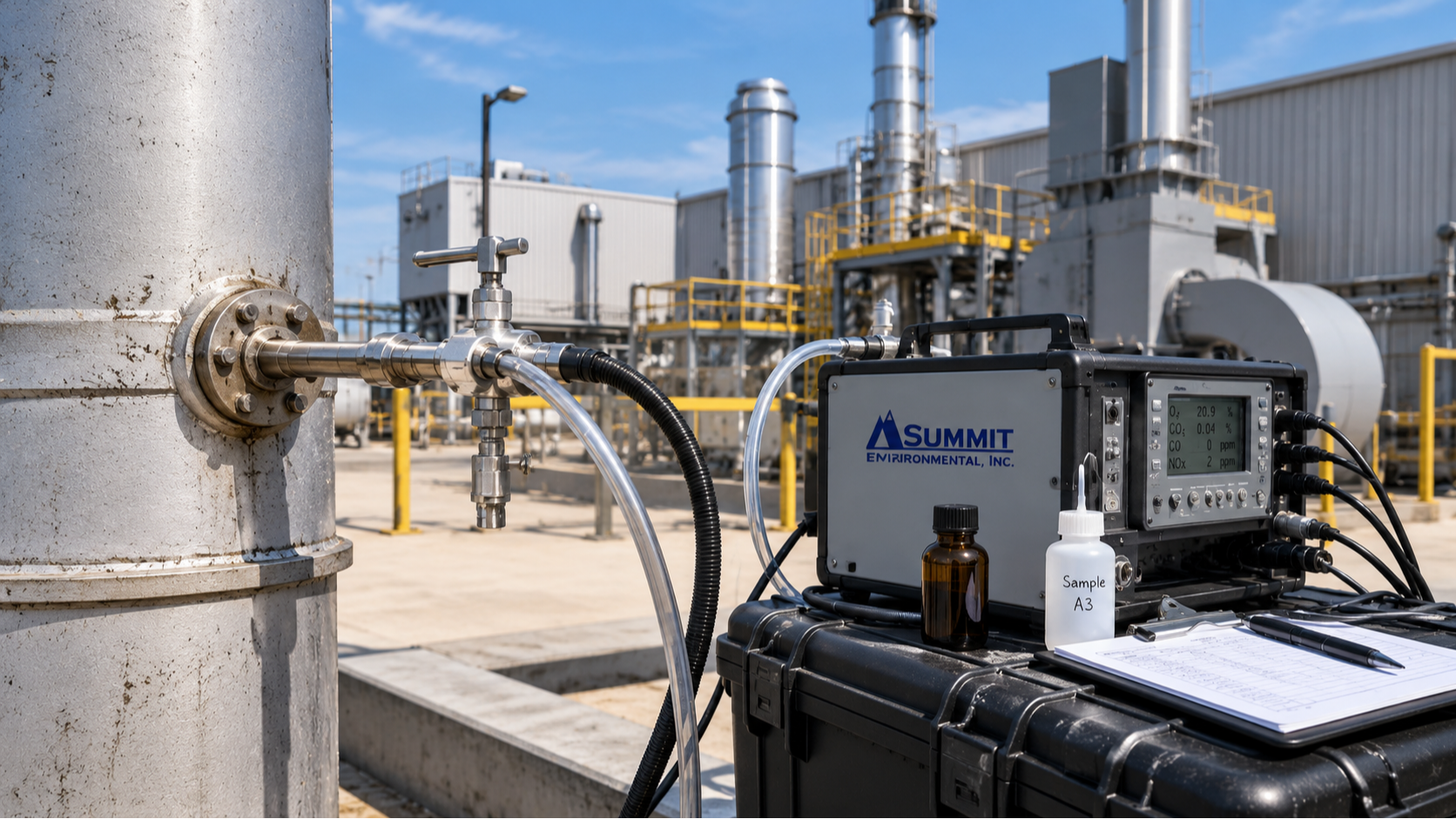
Translate facility operations into clear air-quality obligations.
Summit connects emissions calculations, permitting strategy, monitoring, and operating records so facilities can plan changes and maintain compliance with a defensible technical basis.
Air Permit Applicability & Permitting
New equipment, process changes, increased production, or facility expansion can change air-permitting requirements even when a facility has operated for years.
Summit can evaluate proposed and existing operations to determine whether permitting requirements may apply and prepare process descriptions, emissions calculations, equipment information, operational limitations, and other technical documentation.
The goal is to identify requirements early enough that they can be incorporated into project planning rather than addressed after operations have already changed.
Minor, Synthetic Minor & Major Source Support
Facilities can fall under different permitting frameworks depending on their emissions potential, operating restrictions, and applicable regulatory thresholds.
Summit can assist with evaluating facility status, potential-to-emit, operational limits, and the technical information needed to support minor-source, synthetic-minor, or major-source permitting decisions.
Where enforceable limits are used to manage emissions, those limits should also be practical for the facility to track and demonstrate through normal operating records.
Emissions Inventories & Calculations
An emissions inventory establishes what pollutants may be released from a facility and the quantity associated with each source.
Summit evaluates equipment, process information, fuel and material use, production rates, operating hours, control systems, and other relevant data to develop technically supportable emissions calculations.
A well-developed emissions inventory provides the foundation for permit applicability, reporting, facility expansion planning, and ongoing compliance.
Air Dispersion Modeling
Air-dispersion modeling can be used to evaluate how emissions may move beyond the source and what concentrations could occur at surrounding locations.
Where modeling is appropriate, Summit can support development of source information, operating scenarios, emissions inputs, receptor information, and other technical data necessary for the evaluation.
The value of modeling is using the results to support a permitting, design, or operational decision.
Air Monitoring & Particulate Evaluation
Some air-quality questions require direct environmental monitoring rather than calculations alone.
Summit can develop targeted monitoring programs for particulate matter, dust, ambient conditions, construction or remediation activities, and other projects where airborne conditions need to be documented.
Monitoring locations, duration, methods, and interpretation are selected based on the source, surrounding environment, project objective, and type of information needed.
Compliance, Reporting & Recordkeeping
Air permits often create ongoing obligations after the initial application is approved. Facilities may need to maintain operating records, emissions calculations, material-use information, inspection documentation, monitoring data, recurring reports, or other records demonstrating compliance.
Summit can help translate permit requirements into practical compliance systems that fit the way the facility actually operates, allowing potential issues to be identified before they become reporting or enforcement problems.
Air compliance changes when operations change.
Air emissions are directly tied to facility activity. Production rates, equipment replacement, fuel selection, new materials, process modifications, operating hours, and control systems can all change the environmental profile of a facility.
For that reason, air-quality review should be incorporated into operational planning rather than considered only during permit renewal or reporting.
Summit can evaluate proposed changes before implementation to determine whether they affect emissions calculations, existing permit conditions, permitting thresholds, control requirements, monitoring obligations, or reporting.
This gives facility managers and project teams an opportunity to understand the environmental implications of a change while there is still time to modify the design or operating approach if necessary.
A defensible air program connects emissions data to day-to-day operations.
Summit builds the technical basis for air-quality decisions by connecting actual facility operations with emissions calculations, permit requirements, monitoring needs, and operating records.
As equipment, production, materials, or processes change, that technical basis can be updated so the environmental program remains aligned with how the facility is actually operating.
- Understand operations
- Identify sources
- Quantify emissions
- Determine requirements
- Support compliance
Not sure what air-quality requirements apply to your facility?
Air-quality questions often arise before a facility realizes that an environmental review is necessary. You may be adding equipment, increasing production, changing materials, modifying a process, reviewing an existing permit, preparing an emissions report, or trying to determine whether current operations are adequately documented.
You do not need to determine the permitting category or calculation methodology before contacting Summit. We can review the facility, available permits, equipment information, operating data, and proposed changes to determine the appropriate next step.