Groundwater Investigation
Understand how groundwater moves, where impacts extend, and what the data mean for the site.
Groundwater conditions can influence how contaminants move beneath a property, whether impacts remain localized or migrate beyond the source area, and what type of investigation or remediation may ultimately be required.
Summit Environmental provides groundwater investigation, monitoring, and characterization services for commercial and industrial properties, contaminated sites, redevelopment projects, release investigations, and other locations where subsurface water quality or groundwater movement needs to be understood.
Our work is designed to determine whether groundwater has been impacted, where it is moving, how far contamination may extend, and what additional investigation, monitoring, or corrective action may be appropriate.
Groundwater data need to be understood in the context of the entire site.
A groundwater investigation involves more than collecting water samples from monitoring wells. The results must be interpreted alongside subsurface geology, groundwater elevation, potential source areas, contaminant characteristics, historical site information, and changes observed over time.
Summit reviews available environmental reports, site history, previous sampling results, boring logs, monitoring-well information, potential release areas, surrounding land use, and other relevant information before developing the investigation.
Where additional information is needed, field work may be used to characterize groundwater depth, subsurface conditions, groundwater-flow direction, water quality, and potential contaminant migration.
The objective is to develop a site-wide understanding of the groundwater system so individual analytical results can be interpreted as part of the larger environmental condition rather than as isolated data points.
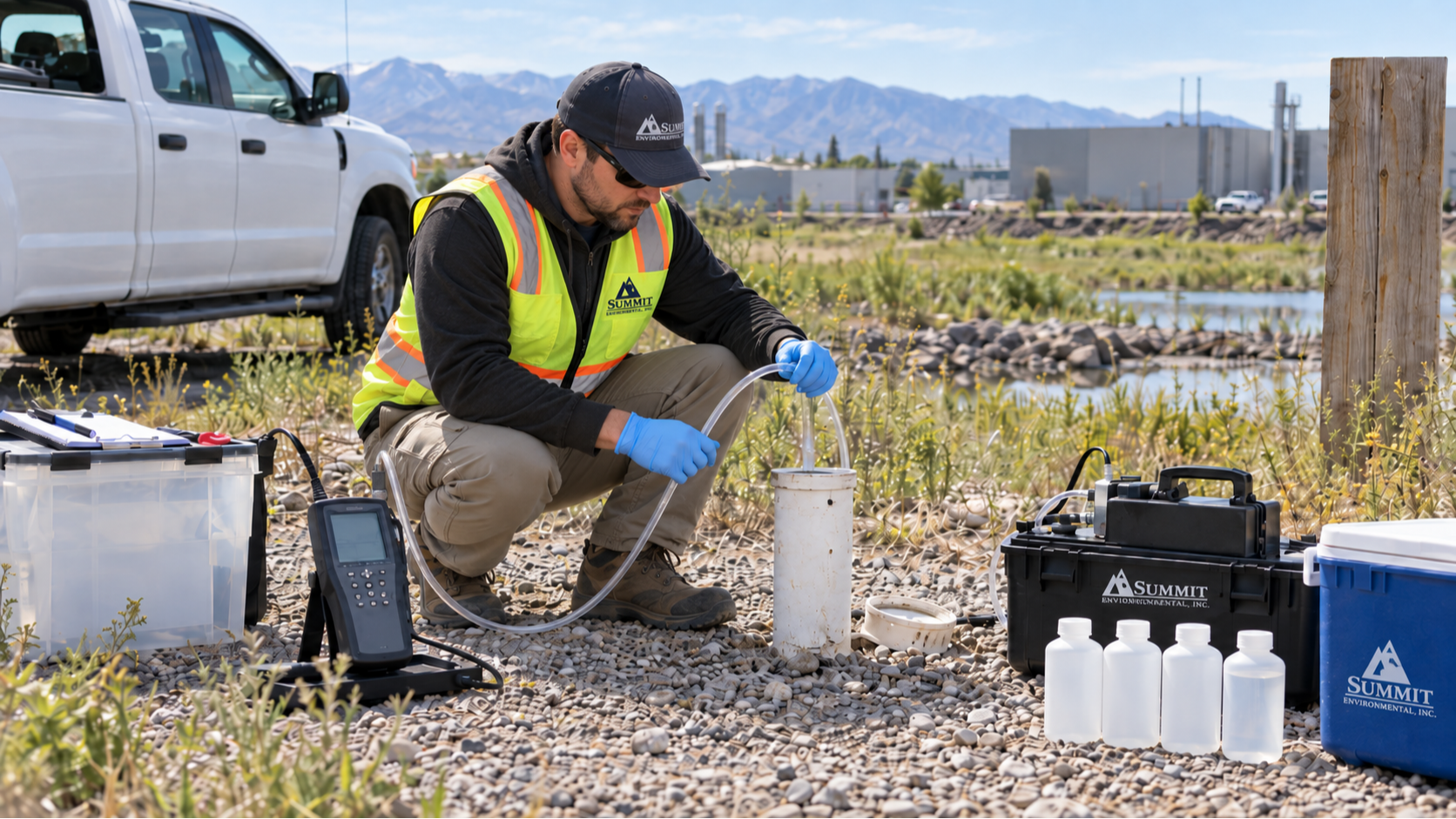
Build a defensible picture of groundwater conditions.
Summit combines monitoring networks, water-level data, analytical results, site history, and subsurface geology to explain how groundwater is moving and how environmental conditions are changing.
Monitoring Well Installation & Groundwater Sampling
Monitoring wells provide consistent access to groundwater for measuring water levels, collecting samples, and evaluating changes in environmental conditions over time.
Summit can support the design and installation of monitoring-well networks based on the suspected source, groundwater depth, subsurface conditions, anticipated flow direction, contaminants of concern, and investigation objectives. Results are interpreted together with well locations, groundwater elevations, historical data, and potential source areas.
Groundwater Flow Evaluation
Understanding groundwater-flow direction is fundamental to determining where contaminants may migrate. Summit measures groundwater elevations across monitoring wells and uses those data to evaluate hydraulic gradients and interpret the direction of movement beneath the property.
Flow information helps determine whether the monitoring network is appropriately positioned and whether downgradient properties, wells, surface-water features, or other receptors may be connected to the source area.
Contaminant Plume Delineation
When contamination is detected in groundwater, additional investigation may be necessary to determine the horizontal and vertical extent of the affected area.
Summit uses monitoring wells, temporary groundwater points, subsurface investigation, and analytical data as appropriate to progressively define the plume. Accurate plume delineation is important because remediation planning, monitoring requirements, off-site migration concerns, and regulatory decisions depend on understanding where impacts begin and end.
Aquifer & Hydraulic Testing
Some groundwater projects require a better understanding of how water moves through the subsurface. Hydraulic testing can provide information about aquifer response, groundwater movement, and the ability of subsurface materials to transmit water.
These data may be useful when evaluating contaminant migration, well performance, groundwater extraction, remediation systems, or other site-specific questions.
Long-Term Groundwater Monitoring
A single sampling event provides a snapshot. Long-term monitoring helps determine whether the groundwater condition is improving, remaining stable, or changing.
Summit can develop and implement monitoring programs based on the site, contaminants, regulatory requirements, and information already available. The purpose is not to collect data indefinitely, but to determine whether additional investigation is necessary, whether remediation is performing as expected, or whether the site is progressing toward an appropriate endpoint.
Groundwater Remediation & Performance Monitoring
When groundwater contamination has been characterized, the appropriate corrective action depends on the contaminants involved, plume configuration, remaining source material, groundwater flow, geology, potential receptors, and long-term objectives for the property.
Summit can support evaluation of remediation options and provide environmental monitoring as corrective action progresses. Results can show whether concentrations are declining, plume boundaries are changing, and the selected remedy is achieving the intended response.
Groundwater is part of a larger subsurface and hydrologic system.
Groundwater contamination frequently originates with a release to soil. Petroleum products, solvents, chemicals, and other contaminants may migrate downward through the soil profile and eventually reach the water table.
Addressing groundwater without understanding the source can result in prolonged monitoring or remediation without resolving the underlying condition.
Groundwater may also discharge to streams, wetlands, ponds, springs, or other surface-water features. Where a plume approaches a receiving water, the investigation may need to consider whether groundwater is creating a potential surface-water pathway.
Summit’s broader capabilities allow these conditions to be evaluated together through our Soil Assessment & Remediation and Surface Water Studies services.
Groundwater data should reduce uncertainty and support the next decision.
Summit interprets groundwater data in the context of source areas, subsurface conditions, groundwater elevations, historical results, and potential receptors. The goal is to reduce uncertainty about how the groundwater system is behaving and what action is warranted.
As new information becomes available, the scope can be refined—whether that means additional delineation, continued monitoring, remediation, or moving the site toward closure.
- Characterize
- Measure flow
- Define the plume
- Monitor trends
- Determine next steps
Not sure what level of groundwater investigation your site requires?
Groundwater projects can begin in many ways. A soil investigation may indicate that contamination has reached the water table. An existing monitoring well may identify an unexpected result. A historical release may require long-term evaluation, or a redevelopment project may need a clearer understanding of subsurface conditions before moving forward.
You do not need to determine the number of wells, sampling frequency, or monitoring strategy before contacting Summit. We can review the available information and develop a groundwater investigation appropriate to the site and the environmental questions that remain unresolved.