Soil Assessment & Remediation
Understand what is in the soil, where impacts extend, and what needs to happen next.
Soil contamination can result from petroleum releases, historical industrial or commercial activities, chemical handling, leaking tanks and piping, spills, fill material, and other past or present site conditions. These impacts are often not visible at the surface and may only become apparent during environmental investigation, construction, redevelopment, or regulatory review.
Summit Environmental provides soil investigation, characterization, and remediation support for commercial and industrial properties, redevelopment sites, release investigations, construction projects, and other properties where subsurface conditions need to be understood.
Our work is designed to determine whether contamination is present, what contaminants are involved, how far the impacts extend, and what corrective action or additional investigation may be appropriate.
Investigation should answer a specific environmental question.
A useful soil investigation begins with understanding the property and why the assessment is being performed. A client may be responding to a known release, evaluating a condition identified during a Phase II investigation, preparing a property for redevelopment, addressing unexpected soil encountered during construction, or working through an existing environmental matter.
Summit reviews the site history, suspected source areas, previous environmental information, planned construction, soil conditions, and project objectives before developing the investigation. Sampling locations, depths, analytical methods, and field procedures are selected based on the condition being evaluated rather than applying the same sampling program to every property.
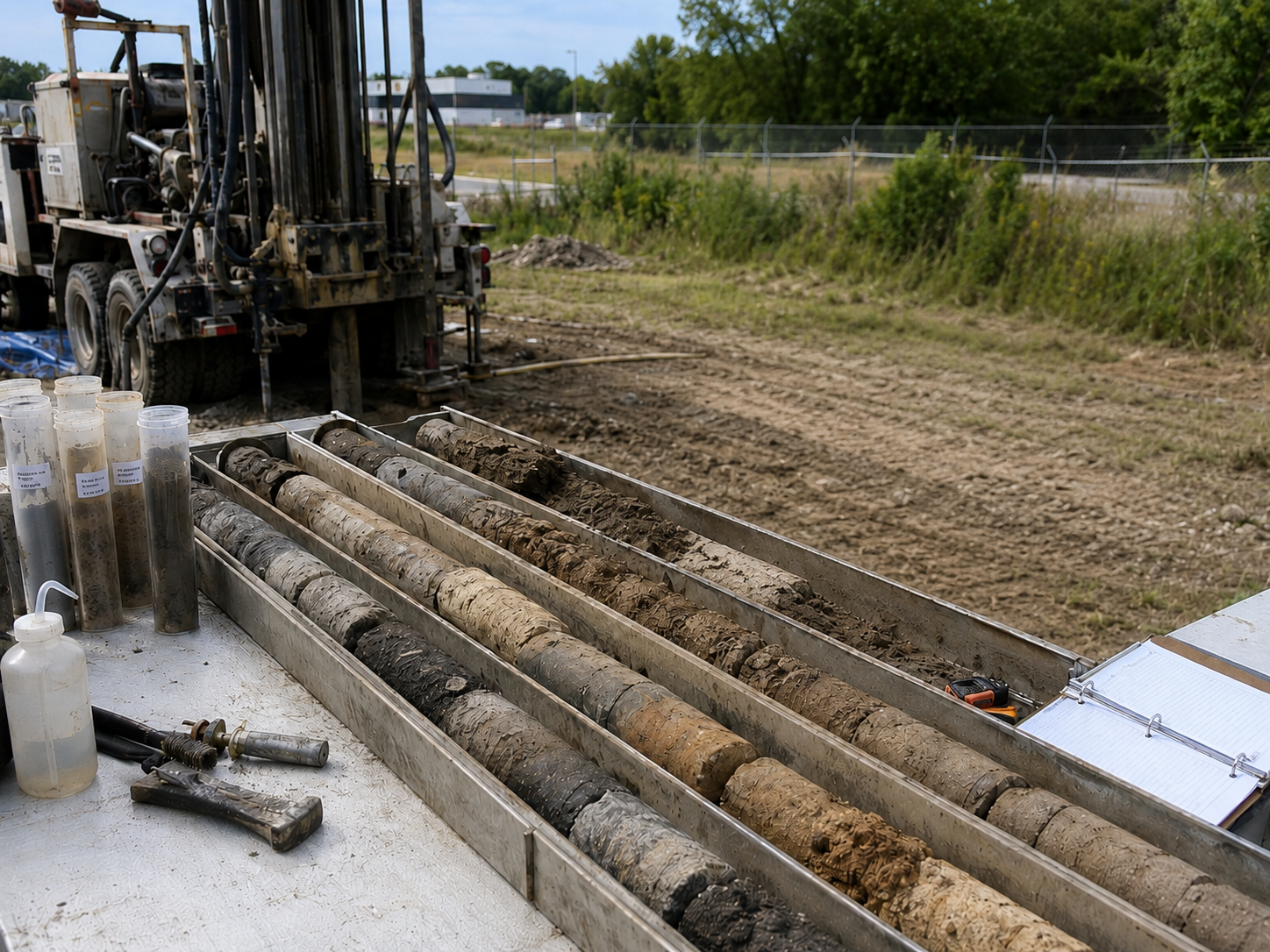
Field investigation may include soil borings, direct-push investigation, test pits, excavation sampling, field screening, or other methods appropriate to the site. Laboratory results are evaluated together with subsurface conditions, field observations, historical information, and the physical relationship between sampling locations.
The goal is to collect enough information to understand the environmental condition and support the next decision—not simply to generate laboratory data.
From initial investigation to documented closure.
Each service builds on the evidence already available, so the work remains focused on defining the condition and moving the property toward a practical resolution.
Soil Investigation & Characterization
Soil investigation is used to determine whether subsurface conditions have been affected by historical or current site activities. Summit develops site-specific investigation programs to evaluate suspected source areas, determine the contaminants involved, and characterize the physical conditions beneath the property.
Investigation results provide the foundation for determining whether additional delineation, groundwater evaluation, remediation, or other action is necessary.
Petroleum-Impacted Soil
Petroleum impacts are common at properties with underground or aboveground storage tanks, fueling systems, piping, equipment maintenance, industrial operations, or historical petroleum use.
Summit evaluates petroleum-impacted soil to determine the location and extent of affected areas and whether contamination appears to remain near the source or has migrated deeper into the subsurface. The investigation can also help determine whether groundwater may be affected and whether excavation, monitoring, or another corrective action should be considered.
Contaminant Delineation
Finding contamination at one location does not establish the full extent of an environmental condition. Summit performs horizontal and vertical delineation to determine where affected soil is located and where concentrations return to conditions consistent with the applicable project or regulatory criteria.
Accurate delineation is important because the boundaries of contamination directly influence remediation planning, excavation volumes, disposal costs, construction decisions, and the need for additional groundwater investigation.
Construction Soil Management
Environmental conditions are frequently encountered during excavation, utility installation, grading, demolition, and redevelopment. Unexpected staining, odors, buried materials, former tanks, or other unusual soil conditions can quickly become a construction-management issue.
Summit can provide field screening, sampling, laboratory coordination, and environmental recommendations while construction is underway. Early characterization can also help establish soil handling, stockpiling, reuse, transportation, and disposal strategies before those conditions affect the project schedule.
Remediation Planning & Support
Once contamination has been characterized, the appropriate corrective action depends on the contaminant, concentration, extent, subsurface conditions, groundwater interaction, property use, regulatory requirements, and future plans for the site.
Summit uses the investigation results to help clients evaluate practical remediation options and can provide environmental oversight, field documentation, sampling, laboratory coordination, and technical support while remediation is performed.
Confirmation Sampling & Closure
Remediation should be followed by documentation showing whether the intended environmental objective was achieved. Summit can perform confirmation sampling following excavation or other corrective work to evaluate the soil remaining within the remediated area.
Where regulatory oversight applies, Summit can also prepare investigation reports, remediation documentation, figures, analytical summaries, and other technical information necessary to support project completion and site closure.
Soil and groundwater are often parts of the same environmental condition.
Contaminants identified in soil can migrate downward through the subsurface and affect groundwater. Groundwater conditions can also influence how a soil investigation is interpreted and whether additional delineation or remediation is necessary.
Summit evaluates these media together when site conditions warrant it, allowing soil and groundwater findings to inform the same conceptual understanding of the site and the decisions that follow.
Investigation → Characterization → Delineation → Remediation → Closure
Summit’s approach begins by understanding the environmental question that needs to be answered. We then develop an investigation appropriate to the property, collect and interpret the necessary field and laboratory information, and determine whether impacts require additional delineation or corrective action.
When contamination is confirmed, the investigation progresses logically from defining the extent of the condition to evaluating remediation options, implementing the selected approach, and documenting the results.
Each stage should provide information that moves the project toward resolution rather than creating an open-ended cycle of additional investigation.
- Investigate
- Characterize
- Delineate
- Remediate
- Document closure
Not sure what level of soil investigation your property requires?
Soil projects can range from a targeted investigation around a suspected release to characterization and remediation of a complex commercial or industrial property. You do not need to determine the sampling strategy before contacting Summit.
If you are dealing with a suspected release, contaminated soil encountered during construction, a condition identified during property due diligence, historical industrial activity, petroleum impacts, or an existing regulatory matter, Summit can review the available information and develop an investigation appropriate to the site.