Recognized Environmental Condition (REC). A condition indicating the presence, likely presence, or material threat of a release of hazardous substances or petroleum at the property, subject to the definitions and exclusions in the ASTM standard.
Building & Indoor Environments / Property Due Diligence
ENVIRONMENTAL SITE ASSESSMENTS & PROPERTY DUE DILIGENCE
Environmental Site Assessments & Property Due Diligence
Understand the environmental history, liability, and condition of a property before it controls the transaction.
Environmental due diligence is not simply a database search or a box to check before closing. A defensible assessment requires historical research, regulatory review, site reconnaissance, interviews, professional judgment, and—when warranted—targeted investigation.
Summit Environmental performs Phase I Environmental Site Assessments, Phase II investigations, property due diligence, environmental report review, and follow-on site characterization for commercial, industrial, agricultural, redevelopment, and complex multi-parcel properties.
Phase I ESA • ASTM E1527-21 • AAI • Phase II ESA • ASTM E1903-19

ENVIRONMENTAL DUE DILIGENCE
An ESA is a structured evaluation of environmental risk—not a simple search for contamination.
A property should be evaluated based on both what exists today and what occurred there historically. Former industrial operations, fueling facilities, tanks, chemical storage, waste handling, agricultural uses, adjoining properties, documented releases, and redevelopment can create environmental issues that are not obvious during a transaction.
A Phase I ESA is designed to identify environmental conditions that may warrant additional attention. It is generally non-intrusive: the objective is not to prove contamination through sampling, but to determine whether the available evidence indicates a recognized environmental condition or another issue that should affect the next decision.
The practical objective: give the client a decision-ready understanding of the property, the environmental evidence, the remaining uncertainty, and what—if anything—should happen next.
WHEN ENVIRONMENTAL DUE DILIGENCE MATTERS
The right scope depends on the transaction, the property, and the question being asked.
A Phase I ESA is not legally required for every real-estate transaction. It is commonly used when environmental liability, lender requirements, redevelopment risk, or the history of a property could materially affect a business decision.
Property acquisition
Before purchasing commercial, industrial, agricultural, or redevelopment property, buyers may use a Phase I ESA to evaluate environmental conditions and support transaction decisions.
Financing & refinancing
Lenders may require environmental due diligence as part of underwriting, refinancing, collateral evaluation, or risk-management procedures.
Redevelopment & change in use
Developers need to understand whether historical uses or existing conditions could affect grading, demolition, construction, disposal, schedule, cost, or future land use.
Portfolio & large-property due diligence
Portfolio acquisitions, multi-parcel holdings, large ranches, industrial campuses, and mixed-use properties often require a more deliberate strategy to evaluate many historical uses and potential source areas efficiently.
Existing owners & prior report review
Owners, attorneys, investors, and prospective tenants may need an independent review of prior reports, changed site conditions, known releases, regulatory history, or environmental obligations before making a new decision.
PHASE I ENVIRONMENTAL SITE ASSESSMENT
The Phase I asks a disciplined question: what evidence indicates a release, likely release, or material threat of a release at this property?
ASTM E1527-21 establishes the current standard practice for Phase I Environmental Site Assessments of commercial real estate. The work integrates multiple lines of evidence rather than relying on any single database, historical map, interview, or site observation.
When used for federal All Appropriate Inquiries, a Phase I can also support one component of certain CERCLA landowner liability protections, provided the applicable requirements and user obligations are satisfied.
01
Historical research
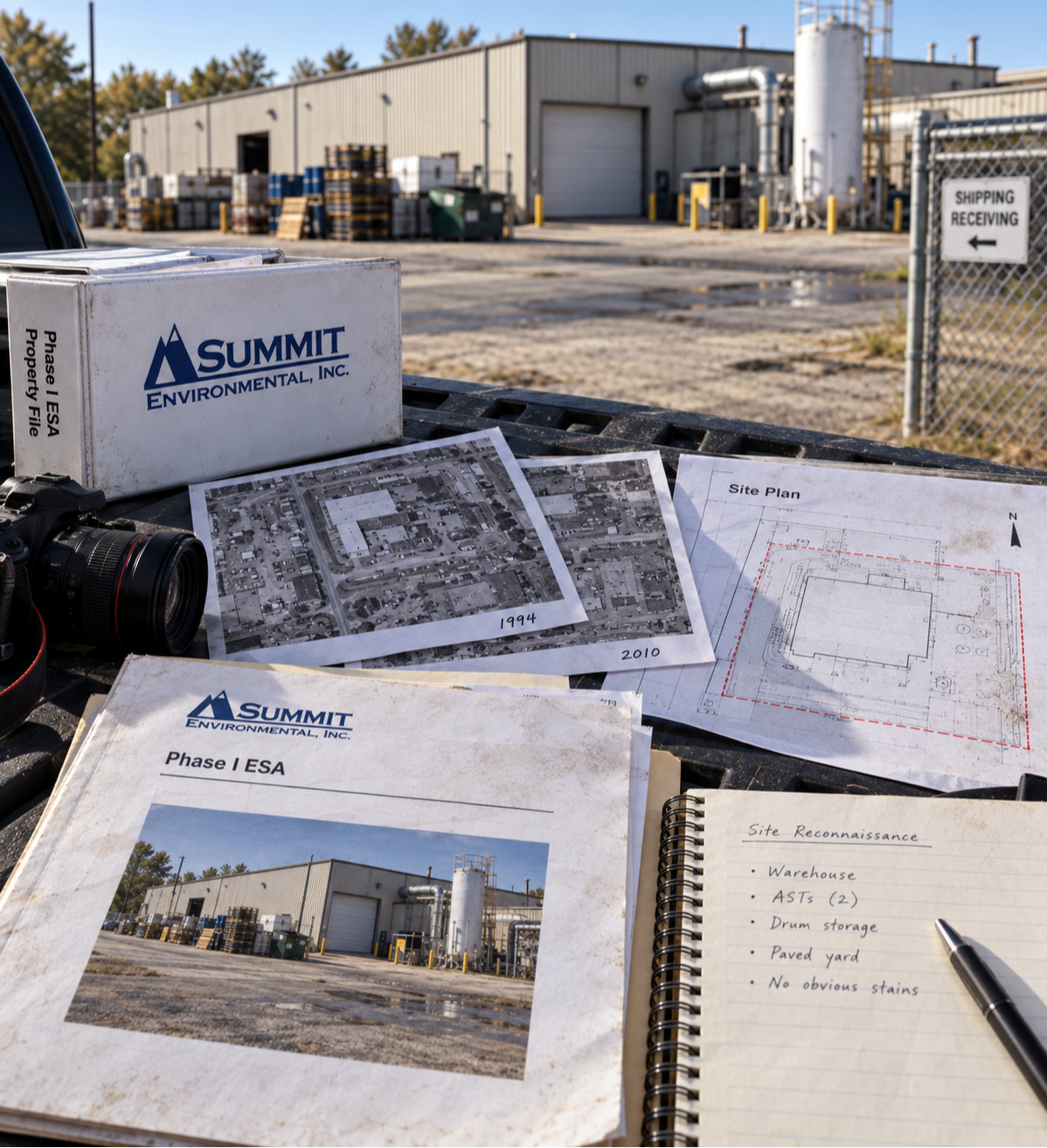
Historical aerial photographs, topographic maps, city directories, fire-insurance mapping where available, ownership/use information, and other historical sources are evaluated to understand how the subject and adjoining properties developed over time.
02
Regulatory records
Federal, state, tribal, and local environmental records are reviewed for the subject property and relevant surrounding facilities. A database hit is not automatically a REC; the information must be evaluated in context.
03
Interviews & user information
Owner, operator, occupant, user, and government information can materially affect the assessment. Environmental liens, activity and use limitations, specialized knowledge, and other user-supplied information may also be relevant.
04
Site reconnaissance
The property is inspected for current conditions, operations, storage, tanks, waste areas, staining, odors, drains, fill, stressed vegetation, evidence of releases, and other features relevant to the assessment. Adjoining-property observations are also considered.
05
Professional evaluation
The environmental professional integrates the evidence, evaluates data gaps and significant data gaps, identifies RECs and other relevant findings, and explains whether additional investigation appears appropriate.
AAI timing matters. For parties relying on All Appropriate Inquiries, the assessment generally must be conducted or updated within one year before acquisition, and certain components must be conducted or updated within 180 days before acquisition.
INTERPRETING THE PHASE I
The conclusion is more precise than “clean” or “dirty.”
ASTM terminology distinguishes different environmental conditions because history, current controls, residual contamination, and future obligations do not all carry the same meaning. The classification should follow the evidence—not a desire to force every finding into the same category.
Controlled Recognized Environmental Condition (CREC). A previously addressed release where contamination remains in place subject to required controls or restrictions.
Historical Recognized Environmental Condition (HREC). A past release that has been addressed to the satisfaction of the applicable regulatory authority or standards in a manner meeting the ASTM criteria for historical classification.
Data gaps. Missing information does not automatically invalidate an assessment. The environmental professional evaluates whether a gap is significant to the ability to identify RECs and documents the effect of that uncertainty.
PHASE II ENVIRONMENTAL INVESTIGATION
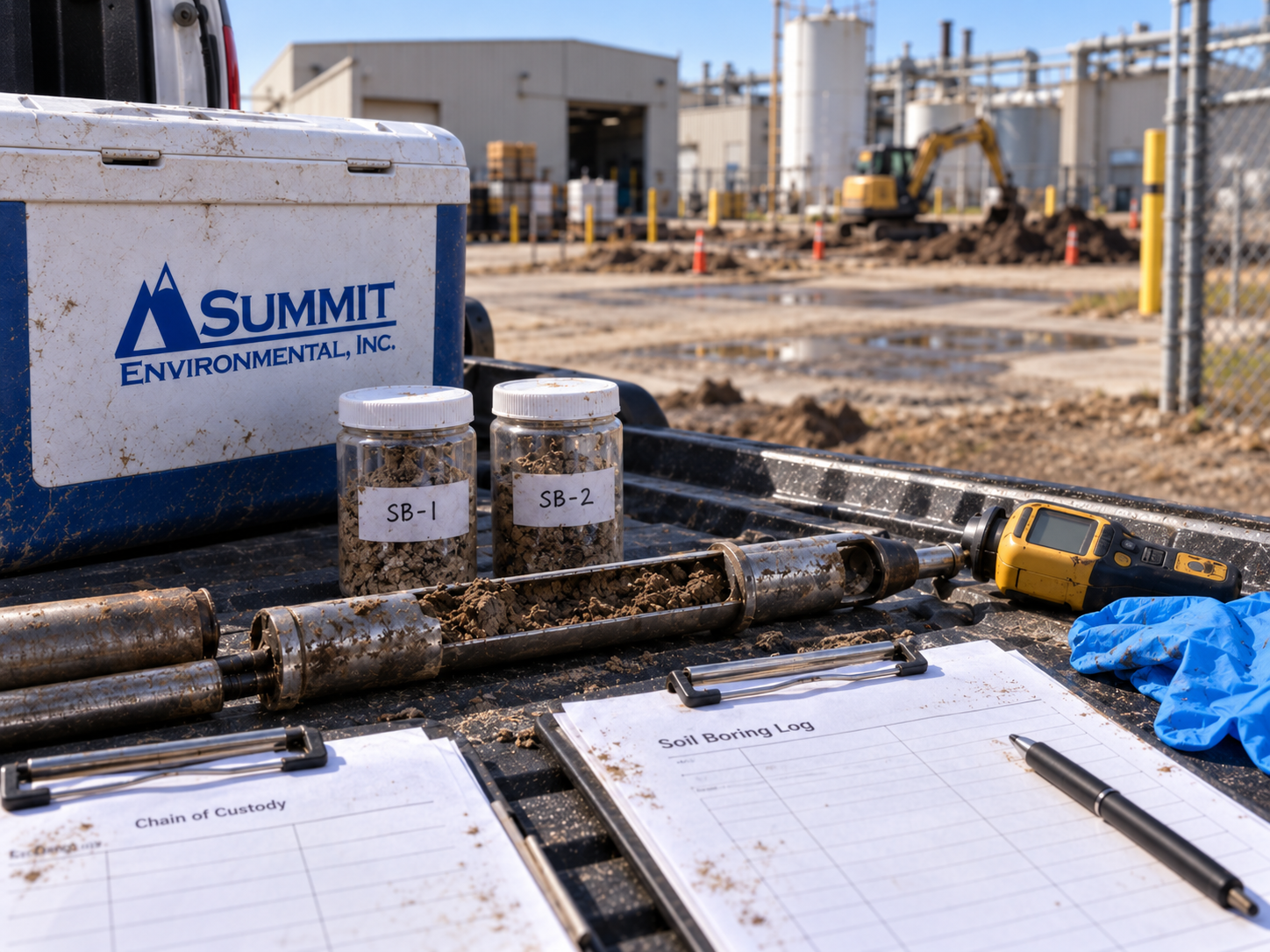
ASTM E1903-19 describes an objective-driven Phase II process based on the scientific method. The scope is site-specific and transaction-specific. Sampling locations, media, analytes, methods, and the degree of investigation should follow the suspected release mechanism, site history, conceptual site model, and the level of confidence needed for the decision.
A targeted Phase II may be sufficient to confirm whether a suspected condition is present. More complex sites may require multiple rounds of investigation to understand source areas, contaminant distribution, migration pathways, receptors, and the limits of affected media.
Define the question
1. Define the objective. What specific uncertainty must the investigation resolve for the transaction, property, lender, regulator, or redevelopment plan?
Build the model
2. Build the conceptual site model. Identify potential source areas, likely contaminants, environmental media, migration pathways, and receptors using the available evidence.
Collect the data
3. Collect representative data. Soil, groundwater, soil vapor, sediment, surface water, or other media may be investigated where appropriate. The sampling program should match the objective rather than default to an arbitrary number of samples.
Interpret the evidence
4. Interpret the evidence together. Analytical results are evaluated with geology, hydrogeology, site history, field observations, data quality, and the conceptual model to determine what the data actually support.
A well-designed Phase II should reduce uncertainty. If the data show that the original question has been answered, more investigation may not be warranted for that objective. If they expose additional uncertainty, the next scope should be tied to that new question.
WHEN INVESTIGATION BECOMES SITE CHARACTERIZATION
The term “Phase III ESA” is sometimes used informally, but it does not describe one universally standardized ASTM phase equivalent to ASTM E1527-21 or ASTM E1903-19. Once contamination is confirmed, the more useful question is what additional work is needed to understand, manage, remediate, or close the condition.
Confirmation → Characterization → Delineation → Corrective Action / Remedial Planning → Remediation → Performance Monitoring → Closure or Long-Term Management
Not every site proceeds through every step. The sequence depends on the contaminants, extent, exposure pathways, regulatory framework, property use, redevelopment plan, and client objective.
LARGE & COMPLEX PROPERTY EXPERIENCE
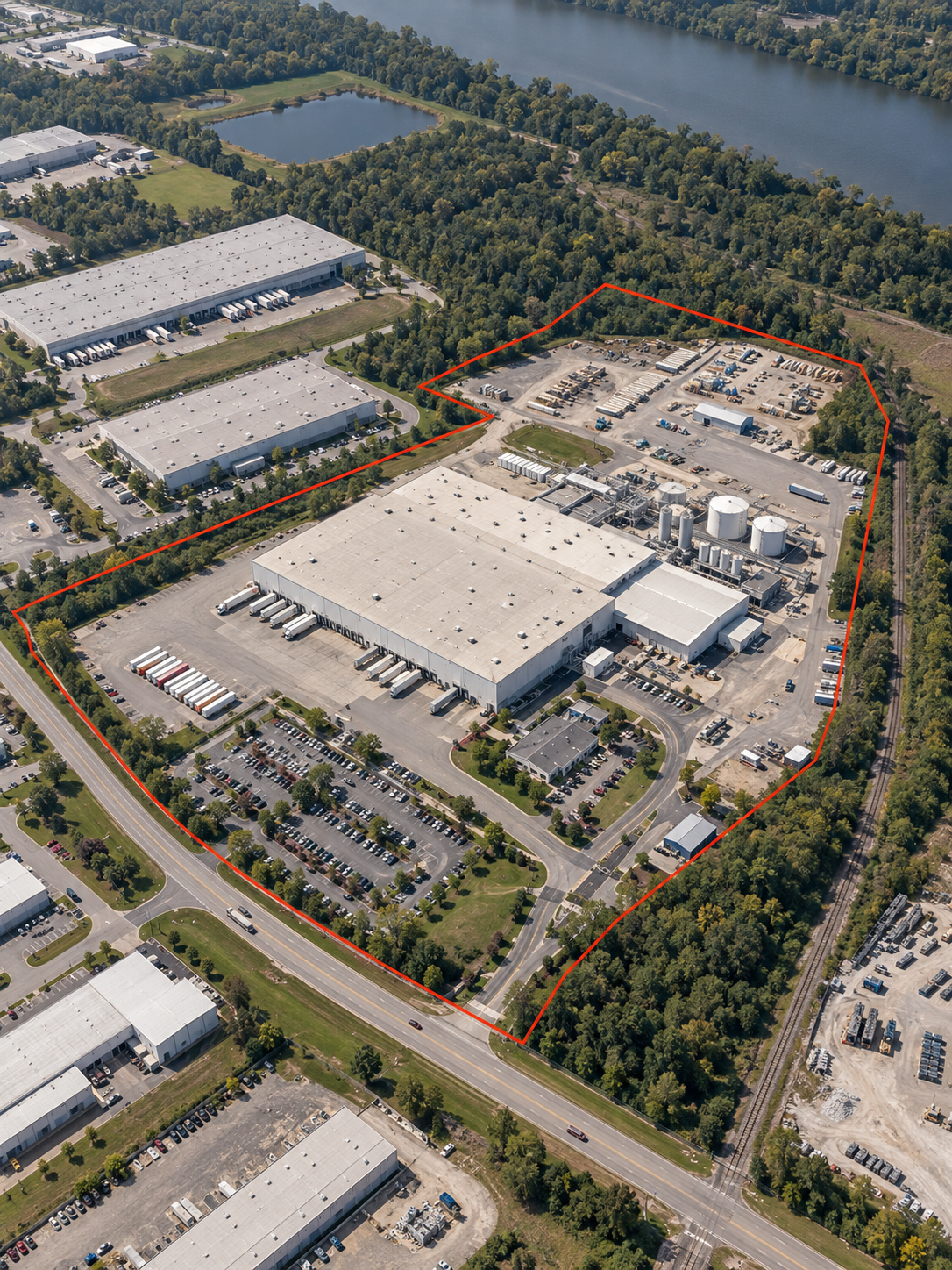
Industrial campuses, agricultural holdings, multi-parcel acquisitions, legacy facilities, large redevelopment sites, and properties with long operational histories can contain many independent source areas and environmental questions. The assessment strategy must distinguish material risks from background noise while still preserving enough coverage to make the conclusions defensible.
That means understanding where historical uses occurred, how the property changed, which areas warrant closer evaluation, how adjoining properties interact with the site, and when the assessment should transition from due diligence into targeted investigation.
Dr. Dorband
Experience matters when the property stops being simple.
Dr. Dorband has performed Phase I assessments, Phase II investigations, and subsequent site characterization work on numerous large and complex properties. That experience is particularly valuable when the site contains multiple historical uses, incomplete records, multiple potential source areas, or a transaction that cannot be reduced to a standard small-property template.
Summit applies that same decision-focused approach to projects of every size: understand the history, identify the meaningful environmental questions, investigate where the evidence justifies it, and explain what the findings mean for the client’s next decision.
SUMMIT’S APPROACH
Research broadly. Inspect critically. Investigate selectively. Interpret the evidence together.
Environmental due diligence should produce an answer that is useful to the transaction or property decision. Summit structures the work around the property and the client’s objective rather than treating every site as the same checklist.
Define the decision and the applicable standard.
Reconstruct the property’s environmental history.
Evaluate current conditions and adjoining influences.
Investigate only where additional data will answer a defined question.
Translate the evidence into clear next-step recommendations.
WHAT A STANDARD PHASE I DOES NOT AUTOMATICALLY COVER
ASTM E1527-21 is intentionally focused. Depending on the property and transaction, additional environmental or business-risk issues may need to be evaluated separately or added to the scope.
Examples may include asbestos-containing materials, lead-based paint, mold or indoor environmental conditions, radon, wetlands, ecological resources, regulatory compliance, vapor concerns beyond the standard scope, and other property-specific issues.
Summit can help determine which additional evaluations are relevant rather than automatically adding every possible test to every transaction.
TECHNICAL FRAMEWORK
The scope should match the standard—and the standard should match the decision.
ASTM E1527-21 — Standard Practice for Phase I Environmental Site Assessments of commercial real estate.
40 CFR Part 312 / All Appropriate Inquiries — Federal requirements relevant to certain CERCLA landowner liability protections and EPA Brownfields work.
ASTM E1903-19 — Standard Practice for the Phase II Environmental Site Assessment process.
ASTM E2247-23 — Phase I standard practice tailored to forestland and rural property and recognized by EPA as consistent with AAI.
ENVIRONMENTAL SITE ASSESSMENT FAQ
Common questions before a transaction becomes an environmental problem.
What is a Phase I Environmental Site Assessment?
A Phase I ESA is a non-intrusive environmental due-diligence process that evaluates current and historical information, regulatory records, site conditions, interviews, and other evidence to identify recognized environmental conditions associated with a property.
Does a Phase I include soil or groundwater sampling?
Not as part of the standard Phase I process. Sampling is generally associated with a Phase II or another targeted investigation when the Phase I or other information identifies a question that requires physical or analytical data.
When does a Phase I lead to a Phase II?
There is no automatic rule that every REC requires the same Phase II scope. Additional investigation is developed around the specific condition, the decision that must be made, the available information, and the level of confidence needed.
How long is a Phase I ESA valid?
For All Appropriate Inquiries, the assessment generally must be conducted or updated within one year before acquisition, with certain components conducted or updated within 180 days. A prior report may still contain useful information, but reliance, user responsibilities, and updated conditions must be evaluated for the specific transaction.
What happens if contamination is confirmed?
The next step depends on what was found and why the information is needed. Additional work may include source-area investigation, horizontal or vertical delineation, groundwater characterization, vapor evaluation, remedial planning, corrective action, monitoring, regulatory coordination, or closure support.
Is there a standard Phase III ESA?
The term “Phase III” is used informally by some practitioners, but there is not one universally standardized ASTM Phase III process equivalent to ASTM E1527 Phase I or ASTM E1903 Phase II. Summit describes follow-on work by the actual objective—characterization, delineation, remediation, monitoring, or closure—so the scope is clear.
EVALUATING A PROPERTY?
Start with the property, the transaction, and the decision you need to make.
You do not need to decide in advance whether the project requires a Phase I, Phase II, report review, or broader due diligence scope. Tell Summit what property is being evaluated, what decision is pending, the transaction schedule, and what information is already available. We can help define the appropriate next step.